What to read before you go to the Mani
TLDR
- •Leigh Fermor's Mani is the reason most English readers know the peninsula
- •It is a 1950s account and the peninsula has changed since
- •The open-access archaeology is better on why the towers exist
- •Tower counts that circulate online do not survive checking
- •Roads only arrived in the 1970s, which explains most of what you see
A short reading list, and one caution.
Mani, by Patrick Leigh Fermor
Published in 1958 and the reason most English-speaking visitors have heard of the peninsula at all. He walked it, wrote it, and later built a house at Kalamitsi and stayed.
Read it for the encounter, not for the facts. It is a 1950s account of a place that had no proper roads until the 1970s, and the peninsula it describes is not the one you will drive through. That gap is interesting rather than a problem.
The archaeology, which is open access and better on the towers
If you want to know why the towers exist, the published fieldwork is more useful than any travel writing, and two of the key papers are free to read.
R. M. Seifried, "The Stone-Built Palaiomaniatika of the Mani Peninsula, Greece", in Deserted Villages, The Digital Press at the University of North Dakota, 2021, doi:10.7275/pt2g-nw28. This is where the real numbers are: over 170 old settlements of 10 to 50 houses each, about half abandoned, and only 16 watch huts and towers recorded across 350 square kilometres of them. It also records that the Mani is absent from the Ottoman tax register of 1460 to 1463, most likely because it had not been conquered.
**Oikonomopoulou et al., in Land 12(8):1579, 2023**, doi:10.3390/land12081579, on the cultural landscape and the xemoni, the walled family compound around a tower.
The caution
Tower counts. You will read that the Mani has 800 towers, or 1,000, or that Vathia has 75. We tried to trace those figures and none of them survives being checked. They are repeated rather than measured, and we do not print one.
The published figures above tell you more than a tower count would, and they have a citation attached.
A second caution, for when you arrive. The peninsula has 206 mapped eating and drinking places and 17 websites between them, on our own count of 24 August 2026. Whatever you read online about a specific taverna, telephone before you drive to it.
One more thing worth knowing
In October 1675, some 730 Maniots sailed from the bay of Oitylo on a Genoese ship and reached Corsica the following March, settling at Paomia in what is now Cargèse. There is still a Greek-rite church there.
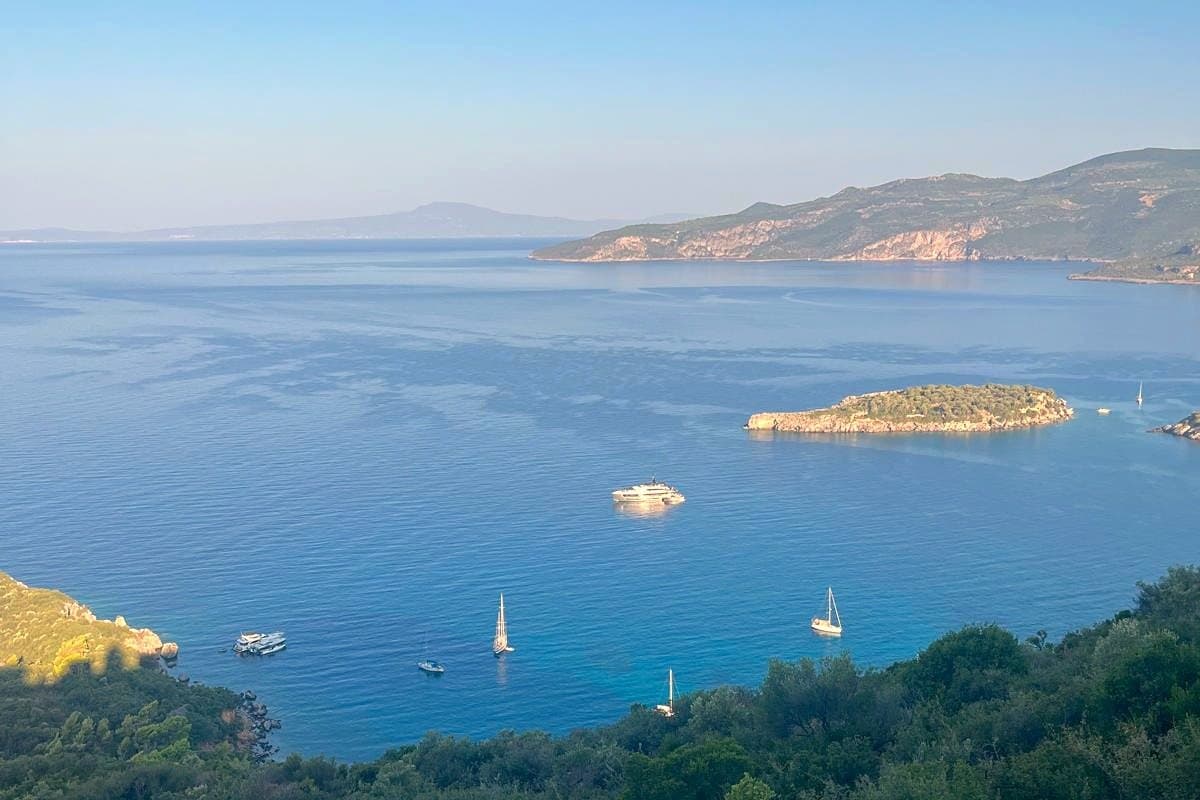
Stand above Oitylo bay with that in your head and the whole peninsula reorganises itself.
More in the wider Mani coast, and the house we use above Kalamitsi is a few hundred metres from where Leigh Fermor wrote.
Frequently Asked Questions
Is Leigh Fermor's Mani still accurate?
As an account of the 1950s, yes. As a guide to the peninsula today, no: roads arrived in the 1970s and changed it substantially. Read it for the writing and the encounter.
Where can I read the archaeology of the Mani for free?
Seifried's chapter in Deserted Villages is open access from the Digital Press at the University of North Dakota, and the Land paper by Oikonomopoulou and colleagues is open access from MDPI. Both are cited in full above.
How many towers are there in the Mani?
No published count survives checking, so we do not give one. The figures that do have citations behind them are about settlements rather than towers: over 170 old settlements, about half now abandoned.